
By The Saltwater Insider Crew · July 2026
Your helm display is the brain of the boat. It shows you exactly where you are, charts a safe course around the hazards you can’t see, marks the numbers where you found fish last trip, and paints a living picture of the structure and bait below your hull. Run without a good one and you’re guessing. Run with the right one and you fish smarter, cruise safer, and get home dry.
A modern chartplotter-fishfinder does three big jobs at once: it navigates with preloaded charts and GPS, it finds fish and structure with CHIRP and scanning sonar, and it ties your whole electronics suite together — radar, autopilot, live sonar, engine data — on one screen you actually want to look at. The good news for 2026 is that even the value units do all three well, and the flagships do them at a level that felt like science fiction a few years ago.
We pulled the units the Captains actually run, from a first real combo for a center console up to the glass helm you’d build a custom sportfisherman around. Every pick below is a chartplotter-fishfinder combo, because if you fish at all — or think you might — buying the combo from the start is the Captain’s money-saving rule. Here’s what belongs at the helm.
Saltwater Insider is reader-supported. When you buy through links on our site, we may earn an affiliate commission at no additional cost to you.
At a Glance
- Best Overall — Garmin GPSMAP 943xsv: the do-everything 9-inch that most serious recreational Captains point to first.
- Best Value — Garmin ECHOMAP UHD2 64sv: real charting and CHIRP sonar at the lowest cost of entry, with Quickdraw Contours mapping the bottom as you cruise.
- Best Budget — Lowrance Elite FS 10: the most screen and Active Imaging sonar you can get before stepping into flagship money.
- Best for Inshore & Nearshore — Lowrance HDS PRO 9: top-tier Lowrance imaging and charting on a console-friendly 9-inch screen for flats, bays, and nearshore structure.
- Best for Serious Sonar — Humminbird APEX 16: the deepest, sharpest MEGA sonar detail in the lineup on a big 16-inch screen.
- Best for Big Offshore Boats — Garmin GPSMAP 8616xsv: the 16-inch glass helm you build an offshore boat around.
How We Picked
Sonar that actually finds fish. A plotter is only half the story. We favored units with strong CHIRP plus quality scanning sonar — ClearVü/SideVü, Active Imaging, or MEGA imaging — and live-sonar capability where it belongs, because seeing bait, structure, and fish clearly is what puts them in the box.
A screen you can read in the sun. Bright, high-resolution, wide-angle displays that stay legible at a hard midday angle and through polarized glasses. Bigger isn’t always better — it’s about matching the screen to the helm and the budget.
A system you can grow. The best helm gear networks. We looked for NMEA 2000 and Ethernet connectivity so you can add radar, autopilot, cameras, and more displays down the road without starting over.
Charts and value that match the mission. Preloaded coastal and inland charting, honest pricing for what you get, and reliable brand support. Every pick earns its slot at its price point — no filler.
Best Overall — Garmin GPSMAP 943xsv
This is the sweet spot for serious recreational boats, and it’s the unit most Captains name when someone asks what to put at the helm. The GPSMAP 943xsv pairs a bright, fast 9-inch display with built-in traditional CHIRP, ClearVü, and SideVü scanning sonar, so you get navigation and real fish-finding in one box.
Preloaded Garmin Navionics+ charting gives you detailed coastal and inland coverage with Auto Guidance+ route planning, and waypoint marking is quick and intuitive — mark the wreck, mark the ledge, run right back to it next trip. Where the 943xsv really earns “Best Overall” is what it lets you do next: it networks radar, autopilot, engine data, and the LiveScope live-sonar system, so you install it once and build your whole electronics suite around it.
Add Garmin’s rock-solid reliability and clean interface, and this is the unit that does nearly everything a recreational Captain needs without overspending on screen real estate you won’t use.
Best for: Serious recreational Captains who want one display to navigate, find fish, and anchor a system they’ll grow over time.
Best Value — Garmin ECHOMAP UHD2 64sv
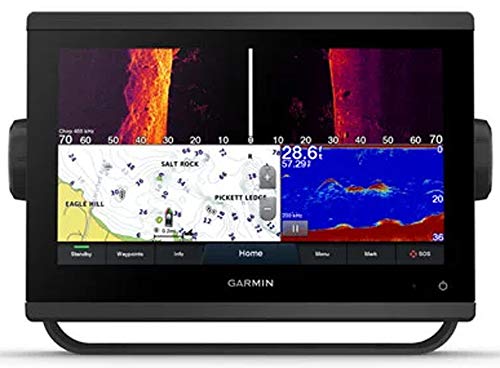
You don’t need flagship money to get onto real marine electronics. The ECHOMAP UHD2 64sv brings quality Garmin charting and CHIRP sonar with ClearVü and SideVü scanning at the lowest cost of entry in this guide — the smart bang-for-buck pick for a casual boater or a first serious upgrade.
The standout feature at this price is Quickdraw Contours, which maps the bottom in one-foot detail as you idle around, building your own private chart of the honey holes no one else has. Preloaded charts get you running right out of the box, and the interface carries Garmin’s easy, familiar feel.
It’s available with or without a transducer, so you can match your setup to the water you fish. For the money, it’s a genuinely capable combo that punches well above its price.
Best for: Budget-minded boaters and first-time upgraders who want real charting and sonar without overspending.

Best Budget — Lowrance Elite FS 10
The Elite FS 10 is the step-up move: the most screen and sonar you can put at the helm before you cross into flagship pricing. You get a bright, 10-inch multi-touch display that’s easy to read and easy to install, paired with the Active Imaging 3-in-1 transducer for CHIRP, SideScan, and DownScan Imaging with FishReveal.
That FishReveal feature is a Lowrance exclusive that overlays CHIRP returns onto DownScan images, so you can actually tell fish from structure at a glance instead of squinting at a smear. The FS is also ActiveTarget live-sonar-ready — add the live module later and watch fish react to your lure in real time.
Preloaded C-MAP charting and full networking (NMEA 2000 and Ethernet) mean you can add radar or autopilot down the line. For a Captain who wants a big, capable, imaging-first screen without flagship money, this is the value-conscious sweet spot.
Best for: Anglers who want a big multi-touch screen and top-tier imaging sonar at a mid-tier price, with room to grow.
Best for Inshore & Nearshore — Lowrance HDS PRO 9
When you’re working the flats, picking apart oyster bars, or running skinny water in the back bays, you don’t need a 16-inch glass helm — you need a bright, fast screen that reads structure cleanly and rides on a console that isn’t the size of a car dashboard. That’s exactly the water the Lowrance HDS PRO 9 was built for.
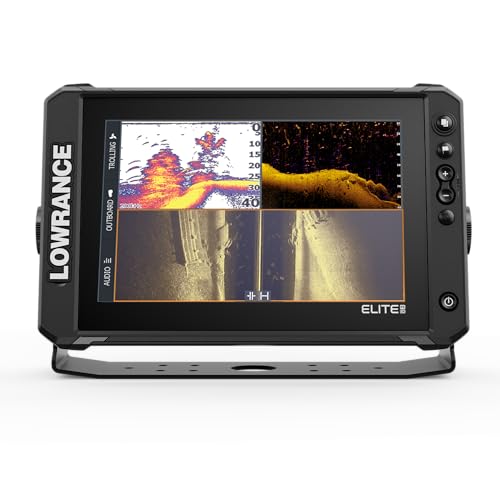
The 9-inch SolarMAX HD touchscreen stays readable in dead-noon glare and straight through polarized lenses, which matters when you’re poling a flat with the sun overhead. Active Imaging HD serves up crisp CHIRP, SideScan, and DownScan, so you can mark a lone rockpile, a dock piling, or a school stacked on a channel edge and get right back on it. Add the ActiveTarget 2 live-sonar module and you’ll watch inshore fish react to your bait in real time — the kind of edge that turns a slow tide into a full cooler.
Preloaded C-MAP DISCOVER charts give you high-detail coastal coverage for running channels and finding cuts, and full NMEA 2000 and radar networking means this unit grows with your boat — trolling motor, Power-Pole, engine data, HALO radar for spotting birds and weather. It’s a real saltwater fishing system sized right for an inshore console.
Best for: Inshore and nearshore Insiders working flats, bays, and coastal structure who want top-tier Lowrance sonar and charting on a console-friendly 9-inch screen.

Best for Serious Sonar — Humminbird APEX 16
If sonar is your religion, the APEX 16 is the cathedral. Its headline act is MEGA Side Imaging+ and MEGA Down Imaging+, delivering detailed underwater views up to 250 feet under and out to either side of your boat — the kind of range and clarity that turns a featureless bottom into a readable map of cover and structure.
Dual Spectrum CHIRP sonar delivers excellent 2D target separation and fish clarity, and the big 16-inch touchscreen gives you room to run split screens without losing detail. Internal GPS with Humminbird Basemap covers 10,000-plus lakes and the continental U.S. coastlines, and it’s compatible with premium LakeMaster, CoastMaster, and Navionics charts.
AutoChart Live even lets you create your own maps of depth contours, bottom hardness, and vegetation as you fish, with hours of built-in recording. For the Captain who buys the boat to run the sonar, the APEX 16 is the pick.
Best for: Sonar-obsessed anglers who want the deepest, sharpest imaging detail on a large, split-screen-friendly display.

Best for Big Offshore Boats — Garmin GPSMAP 8616xsv
When you’re running a serious offshore boat — a custom sportfisherman, a big center console with a full tower helm — you build the electronics suite around one commanding display, and the GPSMAP 8616xsv is exactly that unit. This is a 16-inch full-HD glass helm with the resolution, processing muscle, and networking to run the whole boat: radar, live sonar, autopilot, cameras, and engine data, all tied together and controlled from one screen.
Preloaded Garmin Navionics+ charting, built-in support for CHIRP, ClearVü, and SideVü, and compatibility with the LiveScope live-sonar system mean you see structure, bait, and fish in a class of detail the smaller units can’t touch. Flush-mount two of them edge-to-edge and you’ve got a true glass bridge that looks as good as it runs.
If you want to go even bigger, Garmin’s 8600 series scales up to 22 and 24 inches for a full edge-to-edge glass helm. And no honest offshore conversation skips Furuno — the NavNet TZtouch3 brings legendary commercial-grade sonar that charter and longline Captains have trusted for decades. It’s dealer-rigged gear you spec through a marine installer, but if you’re building a big-boat helm from the keel up, it belongs on your short list.
Best for: Serious offshore vessels where the helm is the command center and nothing but the biggest, fastest, most connected display will do.

Compare All Six
How to Pick the Right Chartplotter
Buy the combo, not just a chartplotter. If you fish at all — or think you ever might — get a chartplotter-fishfinder combo from the start. Adding sonar later almost always costs more than buying it built in, and every unit in this guide is a combo for exactly that reason.
Size the screen to your helm and your wallet. A 6- or 9-inch unit is plenty for a center console; a 16-inch glass helm belongs on a big offshore boat with the dash to hold it. Bigger screens cost more and eat more real estate — match the display to the boat you actually run.
Match the transducer to your water. Your sonar is only as good as the transducer pushing it. Confirm whether your unit ships with a transducer or needs one, and pick the right ducer for your depths — CHIRP and scanning imaging for inshore and coastal, higher-power options for deep offshore.
Buy into a network you can grow. The best helm gear talks to everything else. Look for NMEA 2000 and Ethernet so you can add radar, autopilot, cameras, and extra displays down the road without ripping out and starting over.
Get the charts for where you run. Preloaded coastal and inland charting is standard now, but coverage varies — make sure your unit has detailed charts for your home waters, and consider premium chart upgrades if you fish structure hard or cross into new territory.
See you on the water.